For Kolja Vogel, building IoT products isn’t about dreaming up clever devices. It’s about answering two much harder questions: does this solution actually solve a real problem for customers – and can it survive the real world?
At Identiv, Vogel leads product management for the company’s Bluetooth Low Energy (BLE) portfolio. His work sits at the intersection of engineering, manufacturing, and customer demand – where promising concepts are forced to confront the realities of cost, scale, and deployment.
“My role touches almost every part of the company,” Vogel said. “I’m constantly balancing three things: what our customers actually need, what the technology allows us to build, and what we can realistically manufacture at scale.”
That last piece – scale – is where many IoT ideas collapse.
“In this industry, scale doesn’t mean millions,” Vogel explained. “It could mean hundreds of millions of units. If you can’t manufacture efficiently at that level, the product simply won’t survive.”
Designing for the Real World
This challenge becomes concrete when customers begin exploring how BLE beacons can solve their operational challenges in the real world.
Take something as simple as a shipping label. A logistics company might want to track packages across facilities, or understand where delays occur between distribution hubs. On the surface, it sounds simple – attach a BLE tag and track a package. But the engineering constraints quickly multiply.
Shipping labels must fit standard dimensions, remain printable using conventional printing processes, and operate reliably for only a few weeks. That means every component – from the battery to the antenna – must be carefully right-sized.
“You can’t overspec the design,” Vogel said. “The battery, for example, is one of the biggest cost drivers. If you oversize it, you destroy the economics.”
At the opposite end of the spectrum are customers trying to monitor assets over long periods of time. Here the requirements change dramatically. Tags may need to survive years in the field, operate in harsh environments, and attach to expensive assets where reliability is critical.
“In those cases you’re dealing with completely different constraints,” Vogel said. “You may need ingress protection, smaller form factors, and power systems that last for years.
Every use case becomes an engineering puzzle. The solution isn’t just building a working device – it’s assembling the right combination of technological building blocks to solve a complex customer problem or collect insights from the physical objects they tag with a design that is economical.
Engineering for Efficiency
Many of those design decisions ultimately come down to understanding what the customer actually needs the device to do, and stripping away unnecessary complexity.
Many BLE chips on the market are designed to both transmit and receive data. That flexibility makes sense for devices like smart thermostats or home automation systems. But for many supply chain and tracking applications, the goal is far simpler: gather information about an object and broadcast it efficiently.
“The most power-efficient approach uses a leaner architecture designed for efficiency rather than versatility,” Vogel explained. “You wake up, send a burst of data for a few milliseconds, and then return to deep sleep. That cycle gives you dramatically longer battery life.”
The result is a leaner architecture designed for efficiency rather than versatility.
For Vogel, decisions like these illustrate a broader truth about engineering in the IoT industry: innovation often means subtraction rather than addition.
From Idea to Manufacturing
What makes Identiv’s engineering environment distinctive is how tightly product design and manufacturing are connected.
That connection matters because customers rarely need just a prototype or a proof of concept – they need solutions that can be deployed reliably across thousands or millions of assets.
Many companies separate these disciplines. Engineers design the product, and manufacturing teams figure out how to build it after the design team has achieved their goals. At Identiv, those worlds evolve together.
“It’s not just product development,” Vogel said. “It’s process development as well. You design something, simulate it, prototype it, and then see how it performs on real production machines. The feedback cycle is very short.”
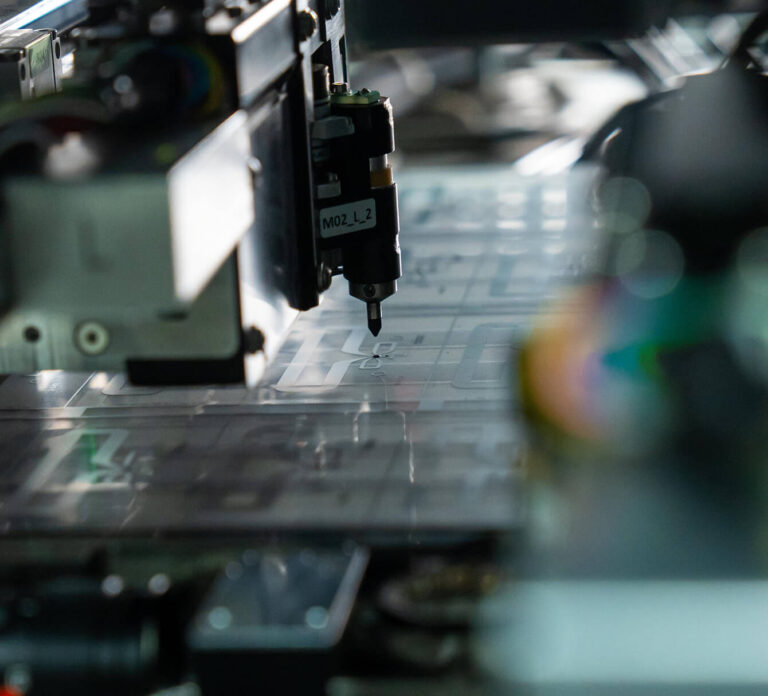
Engineers move rapidly through simulations, antenna prototypes, lab testing, and pilot runs on high-speed production equipment. That tight loop allows teams to iterate quickly and see the real-world consequences of their design decisions.
“In some industries, an engineer might spend years designing a single small component,” Vogel said. “Here, an engineer can design the entire product – and influence how it’s manufactured. That creates a very direct connection between the idea and the outcome.”
Tiny Improvements, Global Impact
Despite the technological complexity of BLE beacons and IoT infrastructure, Vogel is clear-eyed about their impact for customers.
The industries Identiv works with – logistics, food distribution, pharmaceuticals, and more – are already highly optimized. Breakthroughs rarely come in the form of dramatic disruptions.
Instead, progress often happens through incremental gains.
“We’re working in industries where processes have been refined for decades,” Vogel said. “What we’re doing is improving them slightly – sometimes just at the margins.”
But at global scale, those margins matter.
A BLE beacon attached to food shipments, for example, can continuously monitor temperature conditions throughout the supply chain. If produce is exposed to freezing temperatures during transit, the event can be detected early – allowing distributors to intervene before entire shipments spoil.
In other cases, BLE beacons can provide visibility into where goods are moving between locations, how assets are being used, or whether sensitive products are being handled under the right environmental conditions. That kind of insight can help organizations reduce product loss, improve operational planning, and meet increasingly strict safety or traceability requirements.
“Even small improvements can have enormous impact when the system itself is massive,” Vogel said. “That’s how progress usually happens – tiny improvements that accumulate over time.”
The Engineers Behind the Technology
For Vogel, that ability to translate ideas into real-world customer impact is what makes the work rewarding.
Identiv’s engineering culture favors curiosity and hands-on problem solving. Engineers are expected to move across disciplines – prototyping hardware, testing RF performance, and collaborating on manufacturing processes.
“We look for people who are comfortable learning new things and figuring things out themselves,” Vogel said. “It’s not an environment where you only work on one narrow specialty.”
That breadth creates a unique sense of ownership.
“You can influence every aspect of the product – from the first concept all the way through manufacturing,” Vogel said. “If you’re curious and hands-on, that’s incredibly satisfying.”
In the end, Vogel’s job isn’t just about building IoT devices. It’s about making sure those devices can exist in the real world – solving real problems and operating at the scale customers demand.
Because in IoT, the hardest part isn’t building the technology. It’s building a billion of them.