
By Ashley Burkle, Director of Sales & Business Development, Identiv
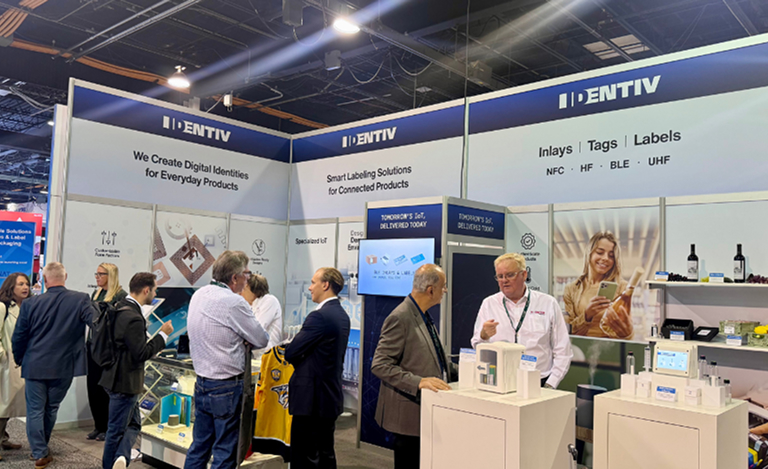
The momentum behind IoT was clear at LOUPE. RFID was everywhere, BLE generated some of the strongest interest, and vendors across the show were focused on turning connected-asset data into actionable insights.
What makes that momentum interesting to me is how familiar many of these technologies already are. RFID has been deployed for decades. BLE is becoming an increasingly mature option for supply chain tracking. Yet the demand for what they provide continues to grow.
AI is clearly an important reason why. Companies investing in AI need detailed, timely data about their operations to generate a return. IoT can supply that data directly from physical goods and assets. AI, in turn, gives companies greater capacity to interpret the information those IoT deployments produce and use it to make decisions.
That relationship is strengthening the case for IoT – and helping explain the interest I saw at LOUPE in both established technologies and newer label formats.
More Detailed Data, Greater Capacity to Use It
IoT labels capture information at the item, package, or pallet level. Depending on the technology and deployment, that can include location, temperature, proximity, and more – with real-time or near-real-time updates.
Knowing a shipment arrived is useful. Knowing where it is and whether its temperature is rising gives AI the context to flag a developing problem, allowing operators to intervene before goods are spoiled or damaged.
This is what makes IoT data so relevant to supply chain AI. The information comes directly from the goods and assets the system is helping companies manage. More frequent, detailed observations can expose delays or changing conditions that periodic records miss.
AI also makes that volume of information more manageable, identifying patterns and prioritizing exceptions for review. Companies have a stronger reason to collect IoT data because they have greater capacity to use it.
RFID’s Maturity Supports Broader Adoption
I recall the earlier days of RFID, when companies needed considerable convincing to justify infrastructure investments and process changes.
At LOUPE, conversations focused on expanding RFID into additional use cases and generating more value – and data – from existing deployments. Teams were exploring how to track more assets and use the resulting data to further improve operations.
Companies with existing RFID infrastructure have already made a substantial part of the investment. They can evaluate additional tagging applications and connect the resulting information to analytics and AI.
RFID’s maturity therefore supports its next stage of adoption. Proven technology and established infrastructure give companies a practical starting point for expanding the data available to their AI investments.
BLE Expands Access to Continuous Data
Demand for more detailed data also helps explain the strong interest in BLE at LOUPE. With appropriate coverage, BLE can provide continuous, real-time visibility between checkpoints and scans. Operators can see how goods move, where they remain idle, and when conditions change throughout their journey.
Some BLE labels can also capture temperature, humidity, and light. That adds context to location data. Knowing where a shipment is becomes more valuable when a company also knows whether it has experienced conditions that could affect product quality.
Frequent updates and varied sensor data give supply chain AI a more complete view of operations. They give systems more information to identify patterns, detect problems earlier, and help operators determine where to intervene. Across many shipments, that data can also reveal recurring delays or environmental conditions that warrant changes to a process.
Advances in BLE label design make this information accessible from more assets. Smaller, printable formats and battery-free options can reduce deployment and maintenance requirements, while compatible existing infrastructure can lower costs. As companies seek richer data to support their AI investments, BLE is increasingly well positioned to supply it.
Match the Technology to the Data Required
Growing interest in IoT data brings more questions about which technology fits each application. The answer starts with the decision a company wants to improve and the information required to support it.
RFID may provide the identification and movement records needed at defined points. BLE may support ongoing visibility or condition monitoring elsewhere. A company can use both across its operations, with each contributing different information.
Deployments combining the technologies reflect a growing understanding of those complementary roles. I expect more in 2027 as companies define their data requirements more precisely.
At Identiv, those requirements guide label design and manufacturing. Reliable operational data starts with labels that perform consistently on the intended assets. As companies invest in AI, that connection between label performance and data quality becomes increasingly consequential to the results they can achieve.