

For Michael Zehnpfennig, successful engineering begins with a clear distinction: invention creates possibility; innovation turns that possibility into something useful, reliable, and commercially successful.
As Vice President of Engineering at Identiv, Zehnpfennig leads global teams across R&D, project management, and product management. His work sits at the intersection of creativity, technical discipline, manufacturing strategy, and market need – where new ideas are evaluated against the commercial requirements that determine whether they can become products.
That perspective has been shaped by more than 20 years in RFID. Trained in physics, Zehnpfennig began his career on the end-user side, helping Metro Group build and operate an RFID test lab during the technology’s early adoption phase. He later managed RFID innovation globally for DHL before moving into manufacturing roles with companies like Identiv.
Across each role, one theme has remained constant: the need to connect creative technical thinking with the structure required to make that thinking valuable.
“Innovation is an invention that is commercially successful,” Zehnpfennig said.
That definition drives much of his work at Identiv. Ideas matter, but the engineering organization must also determine which ideas have market potential, where they create differentiation, how they support customer needs, and whether they can be protected and strengthened through IP strategy.
Creativity Begins With Space to Explore
Zehnpfennig believes invention starts with openness. Engineers need room to explore unusual ideas, test assumptions, and follow paths that may only become clear through experimentation.
For him, that mindset traces back to physics.
Physics trained him to search for context, understand systems deeply, and remain patient when the answer is unclear. One of his university professors described physics education as a process of steadily increasing a person’s tolerance for frustration. That idea stayed with him.
In engineering, frustration tolerance matters because the first answer rarely becomes the final answer. Teams need time to test, fail, understand why something failed, and try again. Creativity requires playfulness, but it also requires resilience.
That is especially true in advanced RFID and IoT development, where small design choices can influence antenna performance, manufacturability, cost, throughput, and customer value. A promising concept must survive technical validation, production constraints, and market reality.
What Photography Teaches About Engineering
Outside of work, Zehnpfennig is an avid photographer. The process has become one of the clearest analogies for how he thinks about engineering.
A strong photograph begins long before the camera shutter is pressed. Zehnpfennig researches the location, studies sunrise and sunset conditions, evaluates tides or weather, reviews how other photographers have approached the scene, and arrives early enough to understand the environment. He tests compositions, adjusts his position, studies the light, and prepares for the moment when the conditions may align.

Engineering follows a similar pattern.
A product launch may appear to culminate in a single moment, but the outcome depends on everything that came before it: research, design, simulation, prototyping, testing, customer feedback, verification, pilot production, ramp-up, and manufacturing readiness.
Zehnpfennig applies the same thinking to Identiv’s work in multicomponent assembly, an area he has focused on for more than a decade. As RFID, NFC, BLE, and sensor-enabled designs become more sophisticated, the challenge expands beyond placing a chip on an antenna. Products increasingly require multiple components, new testing methods, tighter process control, and production systems capable of delivering reliable output at the right cost.
Identiv’s engineering team is working at the leading edge of that challenge. Rather than relying only on available production equipment, the company is advancing new machine approaches and collaborating with equipment partners to improve throughput, reduce cost, and support more sophisticated product architectures.
For Zehnpfennig, that is where engineering becomes most interesting: finding the technology sweet spot where customer need, technical differentiation, manufacturability, and commercial value intersect.
Simple Rules Can Create Complex Results
Zehnpfennig also practices and teaches a meditative sketching methodology known as Zentangle. The process begins with simple rules: mark a space, draw lines, create sections, fill them with patterns, and add shading. Over time, simple inputs create complex results.
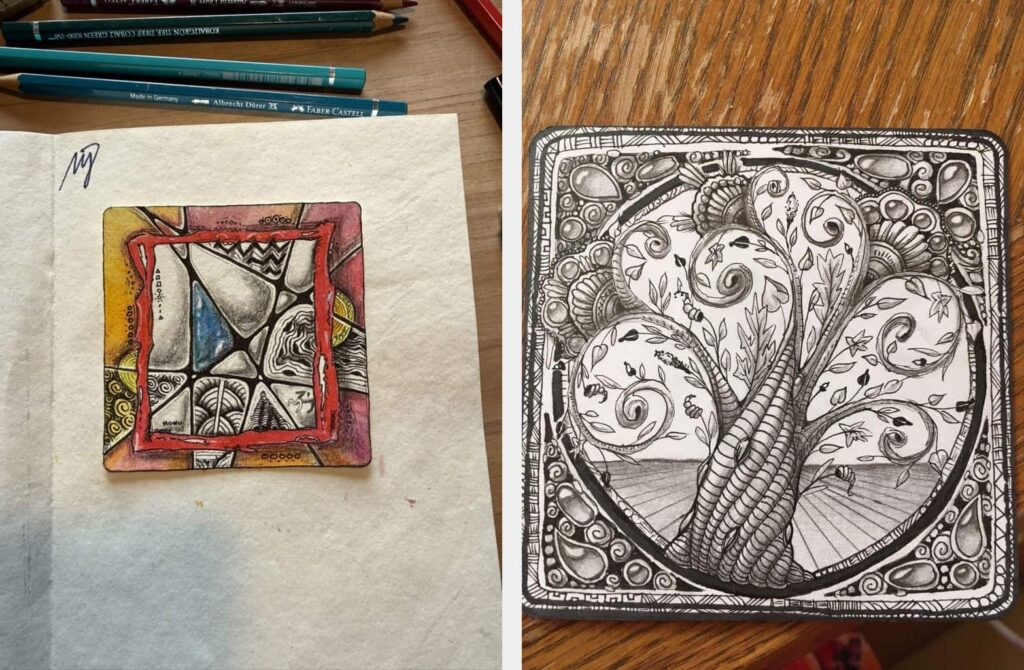
If photography mirrors the disciplined process of engineering innovation – research, planning, preparation, and execution – Zentangle reflects the more open-ended process of invention, where simple elements are explored, combined, and allowed to evolve into something unexpected.
Many breakthrough ideas begin with the freedom to wonder – to follow a question, explore a curiosity, or look at a familiar problem in a different way. That freedom becomes productive when it is combined with small, concrete elements: a component, a material, a production method, a customer constraint, or a technical pattern seen in another industry. The work is to explore those elements, combine them in new ways, and allow new possibilities to take shape.
Photography represents preparation and execution. Zentangle represents emergence and exploration. Identiv’s engineering work requires both.
Process Creates the Conditions for Innovation
At Identiv, Zehnpfennig’s work is also focused on helping engineering teams move creative ideas through a clear, disciplined development process.
That includes applying a disciplined project framework centered on clear business justification, controlled execution, and continual evaluation of project direction.
For Zehnpfennig, the value of this approach is that it keeps teams focused on the right questions: why a project matters, how it creates value, whether the current path remains the right path, and how resources should be aligned as the work progresses.
That structure gives creativity a path into production.
Risk management plays an important role in that process. Identiv teams identify risks, evaluate probability and impact, and define mitigation plans as part of the broader project framework. For Zehnpfennig, this helps engineers stay focused on solving technical problems while ensuring that potential challenges are visible, understood, and actively managed.
The result is an engineering culture where teams across R&D, operations, product management, and project management are closely connected – sharing feedback, aligning priorities, and working together to move complex technologies toward reliable production.
Engineering Leadership Means Building the Right Team
Zehnpfennig describes his leadership style as coaching. He looks for each person’s strengths, identifies what they enjoy, and helps position them where they can contribute most effectively.
Strong teams require complementary capabilities. Some engineers thrive in open research. Others excel at execution, production transfer, testing, or customer problem-solving. The goal is to build an environment where each person’s strengths contribute to the larger system.
That environment also depends on purpose. Engineering work often requires deferred gratification: long development cycles, repeated testing, difficult tradeoffs, and the patience to keep refining an idea before its value is fully visible. For Zehnpfennig, teams need a clear sense of why the work matters to sustain that effort. Purpose helps build the frustration tolerance required to carry an idea through uncertainty and into production.
At Identiv, that purpose is connected to specialized, high-value IoT solutions where engineering depth matters. These are applications where secure identification, advanced assembly, reliable performance, and real-world impact come together.
For Zehnpfennig, that is the purpose of engineering innovation: giving creative ideas the structure, discipline, teamwork, and shared sense of purpose required to become solutions that matter.